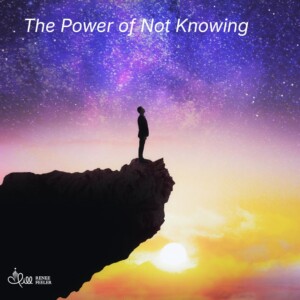
The Power of Not Knowing
Every genuine aha moment expands the field of experience for all of us. Here is how to have more of them.
There is a tendency in human culture to treat certainty as a virtue. We celebrate the expert who has all the answers, the leader who projects total confidence, the scientist who declares that the matter is settled. We organize our institutions, our education systems, and even our social lives around the idea that knowing is better than not knowing. But what if that entire premise is getting in the way of something far more important?
Science is actually the worst place to find certainty. That statement might feel jarring at first, so it bears repeating. Science is the worst place to find certainty. And the reason is simple: certainty limits discovery. The moment a discipline, a culture, or a person decides it knows the answer, curiosity quietly closes its door and walks away. And curiosity, it turns out, is the very engine of everything we have ever learned.
Think about how often humanity has been absolutely sure about something, only to reverse course entirely. For years, people were told not to eat the yolk of the egg. Then the guidance flipped. This pattern repeats across medicine, physics, nutrition, cosmology, and virtually every field of human inquiry. The willingness to say “actually, I was wrong, and here is what I now understand instead” is not a weakness. It is one of the most sophisticated and soulful things a human being can do. It deserves applause.
The most pioneering individuals throughout history have always carried within them a quiet but essential question: what if I am wrong? That question did not paralyze them. It actually coexisted beautifully with the confidence required to take bold action, to fund a research project, to throw themselves out of a proverbial airplane. Confidence and uncertainty are not opposites. The best discoverers hold both at once, and they are more fully alive for it.
There is a specific kind of overconfidence that deserves a closer look, because it rarely feels like overconfidence from the inside. It feels like certainty. It feels like diligence. It feels like knowing your material well enough to teach it. But what it actually does, energetically and socially, is create distance. No one likes a know-it-all, not because anyone doubts their knowledge, but because it simply is not fun. It is not warm. It is not playful. And the absence of warmth and play is not a small thing. It is often the very thing that repels the people you most want to reach, your best clients, your most meaningful relationships, the audiences who would otherwise be drawn to everything you have to offer.
Leading with warmth rather than with credentials creates a fundamentally different experience for everyone involved. When you walk into a room as someone who is curious rather than certain, you become someone people want to be near. They want to hear your questions as much as your answers. They feel welcomed rather than lectured. That shift in energy is not a compromise of your intelligence or your expertise. It is actually an upgrade to how your intelligence lands in the world.
There is also the matter of urgency, that persistent feeling that the clock is ticking, that the world needs the right answers now, that there is no time to slow down or soften. This sense of urgency, however well-intentioned, tends to activate the parts of us that push hardest and listen least. And it is worth asking a simple but sobering question: if time truly were limited, what would you most want your lasting impression to be? Probably not what you knew. Probably not what you taught. Most likely it would be how someone felt in your presence, how loved they felt, how seen.
Einstein carried a deep and sometimes inconvenient humility with him throughout his work. His uncertainty was frustrating to colleagues who wanted a confident all-knowing figurehead. But it was precisely that uncertainty, paired with extraordinary curiosity, that made the great discoveries possible. He did not arrive at his most profound insights through confidence. He stumbled across them. The bigger the discovery, the more it felt like a kind of falling upon rather than a decisive arrival. That story rarely gets told. Only the triumphant versions get passed down, which is a shame, because the real story is far more useful.
The greatest pioneers of any kind are not the loudest voices in the room. Quiet curiosity tends to be just that: quiet. It is highly observational. It does not broadcast its process. You cannot observe deeply while your mouth is open. You cannot take in what is genuinely new if you are already explaining what you think you know. Sitting alone, walking, being in nature without an agenda, that is often where the real aha moments live.
Every genuine aha moment is an expansion of the entire field of human experience. One person, in one quiet moment of genuine not-knowing, can widen what is available to all of us. That is not a small thing. That is actually how the world changes, not through forceful certainty, but through someone being humble and curious enough to let something new come through.
For those who are devoted to teaching, to helping, to solving real problems and offering real answers, there is a gentle but important invitation here. The role of teaching is endless. There will always be more to explain, more to correct, more to share. The ditch will always fill back up. And if that is true, then perhaps the goal is not to dig more efficiently but to ask whether all that digging is the most powerful contribution you can make. What if the same impact, or even greater impact, were available with far less effort? What if your warmth, your presence, and your willingness to not know were actually priming the people around you for their own discoveries in ways that your best lecture never could?
This is not an argument against teaching. It is an invitation to fall back in love with the part of you that does not have the answer yet. That uncertain, open, genuinely wondering part of you is extraordinarily lovable. It is unintimidating. It creates space. And it is far more likely to spark something real in another person than a perfectly delivered explanation ever will.
The most cherished moments of any life are rarely the ones where you got the answer right. They are the ones where you were fully present with someone you love, where nothing needed to be solved or explained, where the only thing happening was the warmth of being together. That is not a distraction from your purpose. That may actually be the deepest expression of it.
Make friends with not knowing. Be open about it, at least to yourself. Trust that your intentions are good, that curiosity is enough to move you forward, and that the field of experience for all of us expands every time one person is brave enough to say: I wonder.
This blog post emanates from a live message Jill shared live with her membership community. We hope you enjoy it and that it helps you create even more layers for your soulfulness to be, here.



Leave A Comment